
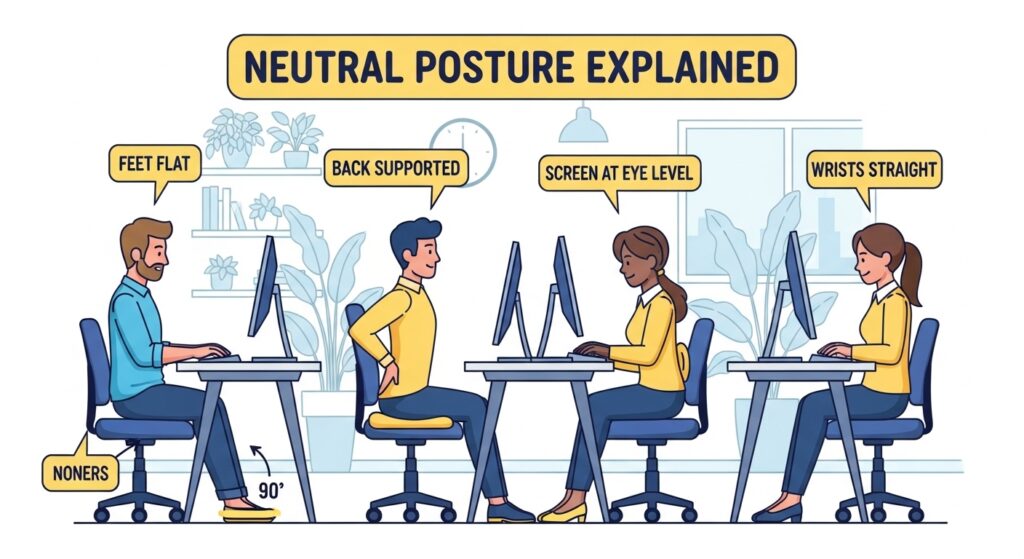
Neutral Posture Explained: What It Really Means in Practice
Neutral posture is a key principle in ergonomics, yet it is often misunderstood. Many people associate good posture with sitting perfectly straight, but neutral posture is not about rigidity. It refers to positioning the body in a way that keeps joints naturally aligned, muscles balanced, and physical strain minimised during work activities.
What is neutral posture?
In a neutral posture, the head is aligned over the shoulders, the shoulders remain relaxed, and the natural curves of the spine are supported. The arms stay close to the body with elbows bent comfortably, while the wrists remain straight during keyboard or mouse use. At the lower body, the hips are positioned level with or slightly higher than the knees, and the feet are fully supported on the floor or a footrest. When these elements are aligned, the body requires less effort to maintain posture, reducing fatigue and discomfort.
Common myths
However, neutral posture does not mean holding a single position for long periods. Even the best posture can become harmful if it is maintained without movement. Prolonged static sitting places continuous stress on muscles and joints, increasing the risk of musculoskeletal discomfort over time.
Importance of movement
This is why movement is a critical part of neutral posture. Regular posture changes, short breaks, and brief periods of standing or stretching help the body recover and maintain alignment. A commonly used ergonomic principle is that the best posture is the next posture.
Key Message
In practice, neutral posture should feel comfortable, supported, and easy to maintain. If a posture feels forced, tiring, or painful, it is no longer neutral. The goal is not perfection, but a sustainable working posture that supports long-term health and productivity.